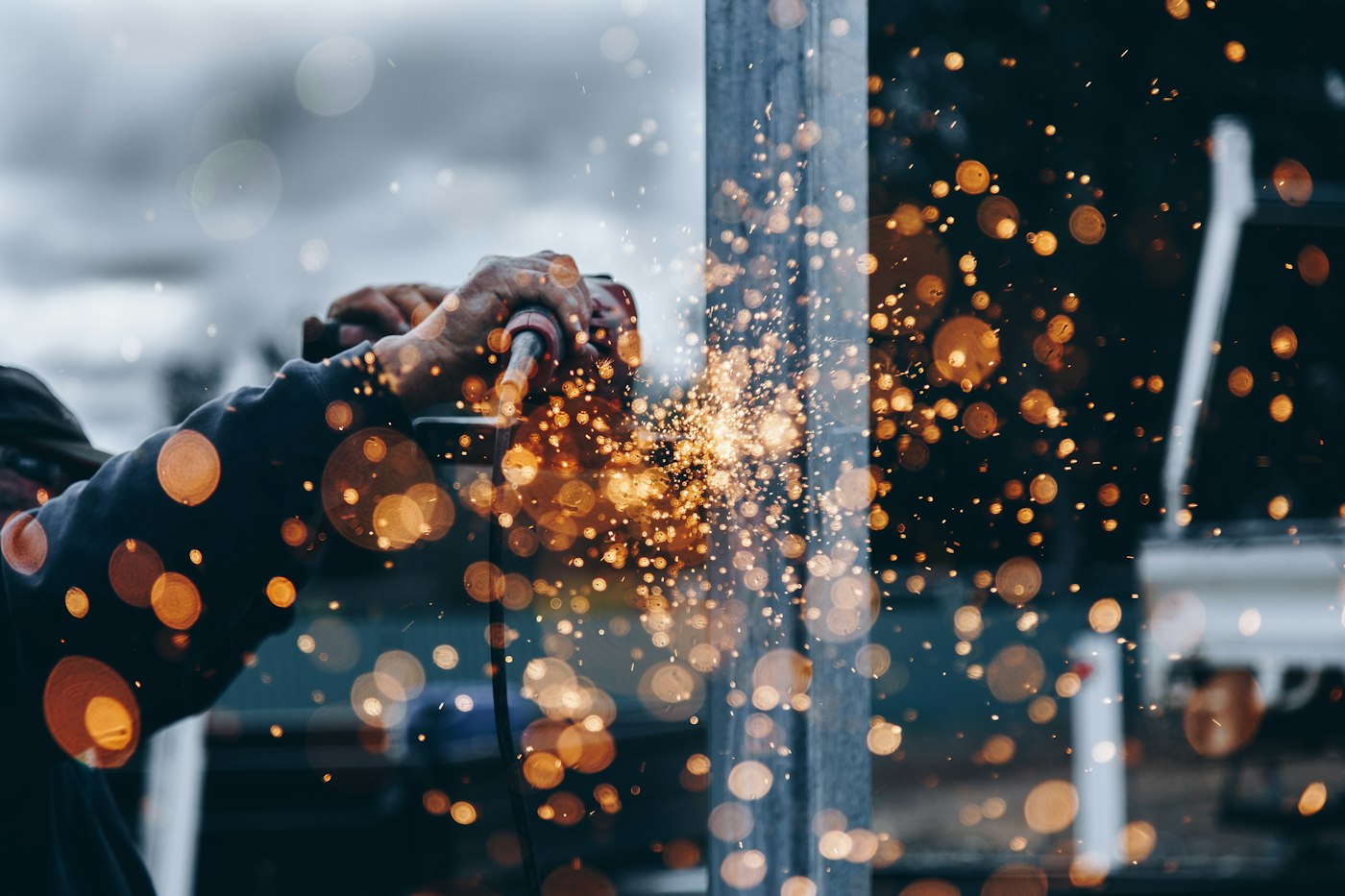
Two of the most dominant manufacturing processes for brass components are Hot Forging and CNC Machining (turning and milling). While many parts can technically be produced using either method, selecting the correct process is essential for balancing unit cost, structural integrity, and production scalability.
How Brass Hot Forging Works
In hot closed-die forging, a brass billet (often an alloy like CW617N) is heated to its plastic deformation range, typically between 680°C and 780°C. The hot billet is then placed between custom steel dies and squeezed under immense pressure. The brass flows into the cavities of the die, taking on a near-net shape.
Pros:
- Superior Strength: Forging refines and aligns the grain structure of the brass to the shape of the part, resulting in higher impact strength and zero porosity.
- Material Efficiency: Since the material is reshaped rather than cut away, there is significantly less scrap, making it ideal for bulky or irregularly shaped parts.
- High Volume Speed: Once the dies are made, forging cycles are incredibly fast.
Cons:
- High initial tooling (die) costs.
- Secondary machining is still required for threads and tight tolerance dimensions.
How CNC Machining Works
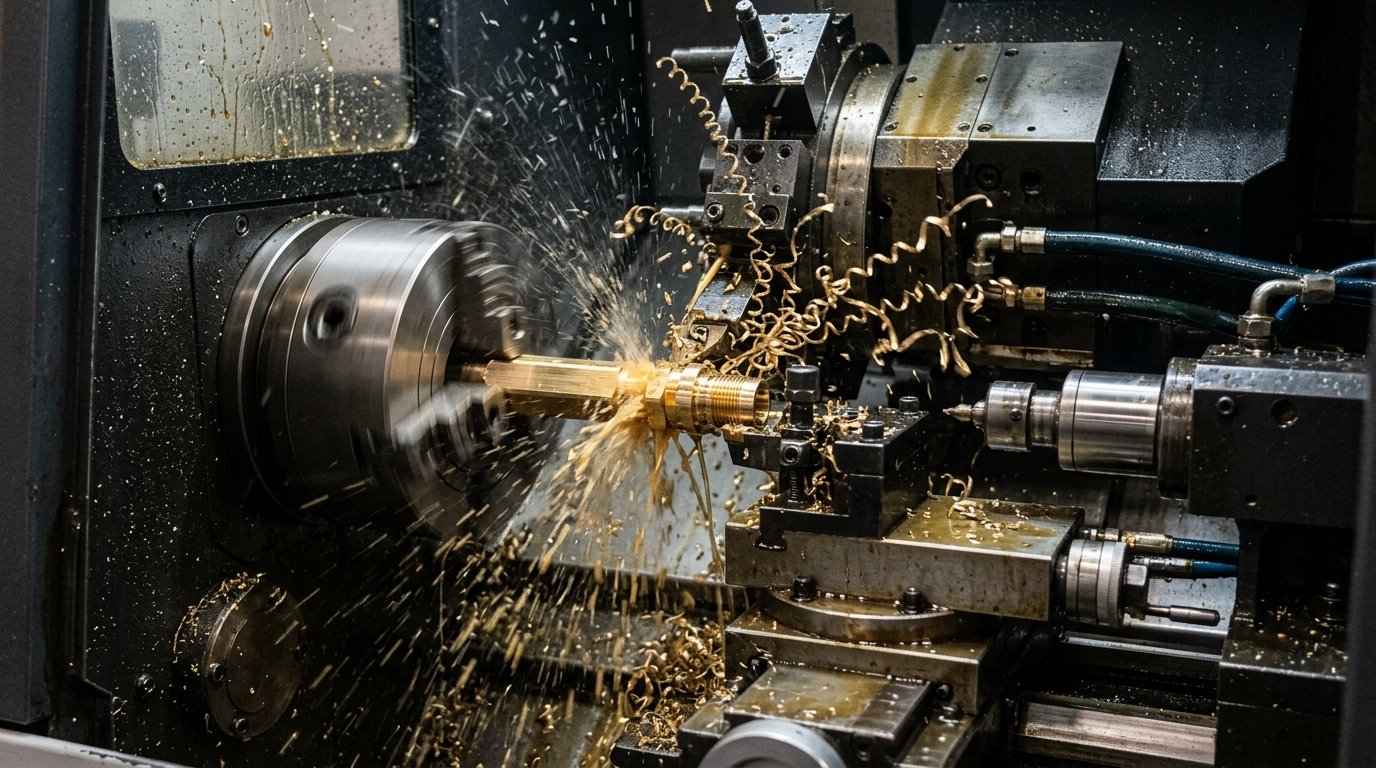
CNC machining is a subtractive process. It starts with solid extruded brass rod or bar stock (typically CW614N for its 100% machinability rating). Computer-controlled lathes and mills remove material to achieve the final shape with extreme precision.
Pros:
- Tight Tolerances: Achieves micron-level precision and excellent surface finishes right off the machine.
- No Tooling Costs: No dies are required, meaning prototyping and low-volume production runs are highly economical.
- Flexibility: Design changes can be made instantly by updating the CNC program.
Cons:
- High material waste on complex or bulky shapes.
- The grain structure is interrupted by the cutting process, offering slightly lower mechanical strength compared to a forged counterpart.
When to Use Which Process
| Factor | Choose CNC Machining | Choose Hot Forging (with secondary machining) |
|---|---|---|
| Part Geometry | Cylindrical, symmetrical, straight profiles (e.g., pins, fasteners, simple inserts) | Complex, bulky, multi-axis shapes (e.g., valve bodies, T-fittings, angled components) |
| Production Volume | Low to Medium (100 to 10,000 pcs) | High (10,000+ pcs to amortize die costs) |
| Mechanical Stress | Standard applications | High pressure, high impact, zero-porosity required (e.g., gas and high-pressure fluid valves) |
| Tolerances | Extremely tight (microns) | Moderate to tight (requires secondary machining for threads/seals) |
Cost Comparison Dynamics
The crossover point where forging becomes cheaper than machining heavily depends on the buy-to-fly ratio (how much raw material is purchased versus how much remains in the final part). If you are turning a massive block of brass into a hollow T-fitting on a CNC machine, you might waste 70% of the material as chips. In that scenario, the tooling cost for a forging die pays for itself very quickly due to raw material savings.
At Divine Brass Industries, we offer both world-class Custom Forging and precision Turned Parts, allowing us to guide you to the absolute best manufacturing process for your specific design.
Frequently Asked Questions
When is hot forging superior to CNC turning for brass parts?
Hot forging is ideal for high-volume parts (>10,000 units) with complex 3D geometry (like T-valve bodies), reducing raw material scrap by up to 50% compared to machining solid block stock.
Does hot forging improve the mechanical burst strength of brass valves?
Yes. Hot forging compresses internal porosity and aligns the metallic grain structure along part contours, increasing burst pressure ratings by 30% over bar-machined valve bodies.
Which alloy is recommended for hot brass forging?
CW617N (CuZn40Pb2) and CZ122 are the premier alloys for hot closed-die forging due to their high plastic ductility at 700°C.