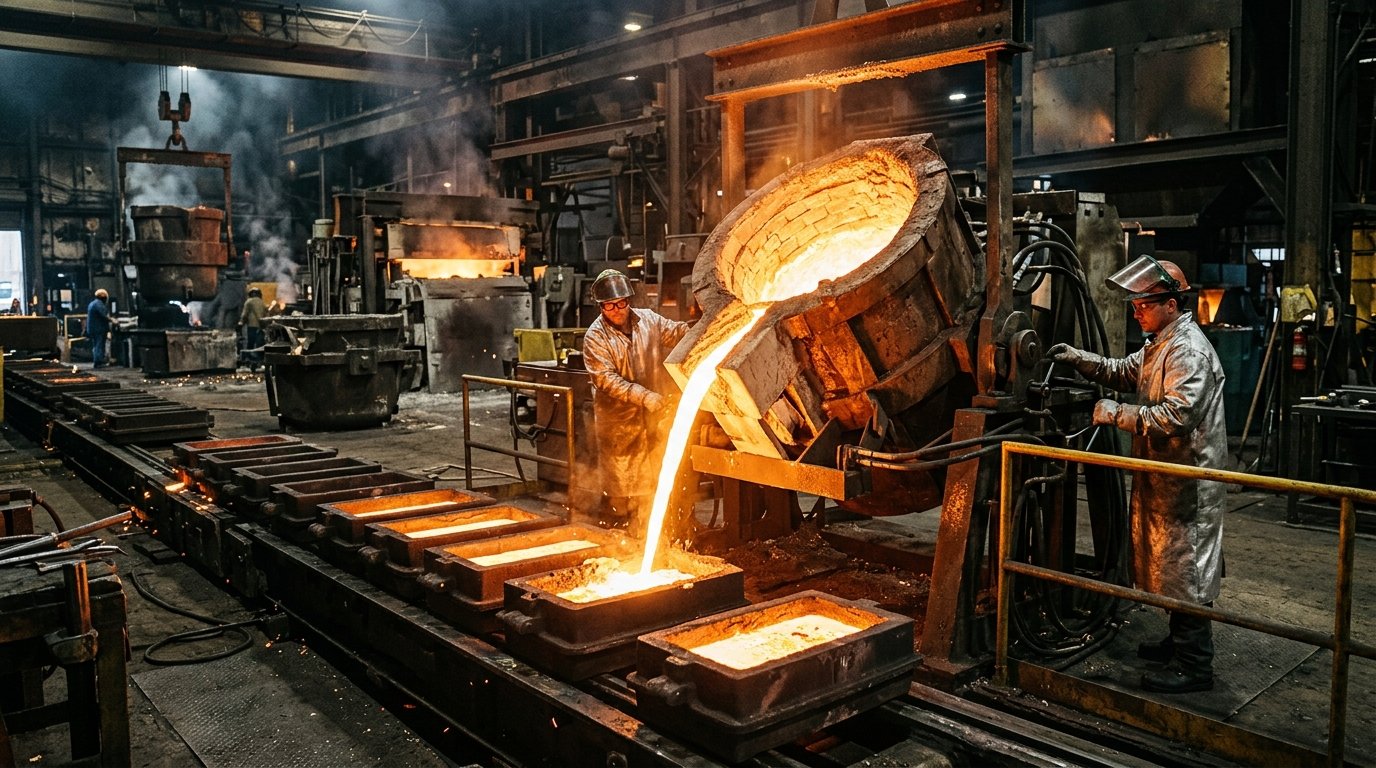
While forging and machining dominate high-volume brass manufacturing, casting remains a vital process for creating large, intricate, or highly customized brass components. Brass casting involves pouring molten brass into a mold cavity to achieve a desired shape, a process as ancient as civilization but highly modernized today.
Common Types of Brass Casting
Several distinct casting methods are utilized in the industry, each suited to different component requirements:
- Sand Casting: The most common and economical method for low-volume or large parts. A pattern is pressed into specialized sand to create a mold cavity. Molten brass is poured in, and the sand is broken away once cooled. Surface finishes are generally rougher.
- Die Casting: Molten brass is forced under high pressure into reusable steel molds (dies). This method is excellent for high-volume production, yielding excellent dimensional accuracy and smooth surface finishes.
- Investment Casting (Lost Wax): A wax pattern is coated in ceramic. The wax is melted out, leaving a highly precise ceramic shell into which brass is poured. This is ideal for incredibly complex, highly detailed parts that require little to no secondary machining.
- Centrifugal Casting: Molten metal is poured into a spinning mold. Centrifugal force pushes the metal to the edges, creating dense, defect-free cylindrical shapes, often used for large bearings and rings.
The Casting Process and Shrinkage
The general casting process involves melting the brass alloy (typically at temperatures exceeding 900°C), preparing the mold with necessary cores (to create hollow spaces), pouring, cooling, and knockout.
A critical engineering consideration in casting is shrinkage allowance. As molten brass cools and solidifies, it shrinks. Patternmakers must design molds slightly oversized—typically around 1.5% to 2% larger for brass—to ensure the final cooled part meets dimensional specifications.
Casting vs. Forging
| Characteristic | Brass Casting | Brass Forging |
|---|---|---|
| Part Size | Can produce massive parts (hundreds of kg) | Limited by press tonnage (usually smaller parts) |
| Internal Geometry | Excellent (using sand cores for hollow cavities) | Limited (cannot forge complex internal voids) |
| Mechanical Strength | Good, but prone to micro-porosity | Superior (dense, aligned grain structure) |
| Tooling Cost | Low (especially for sand casting) | High (expensive steel dies) |
Post-Casting Operations
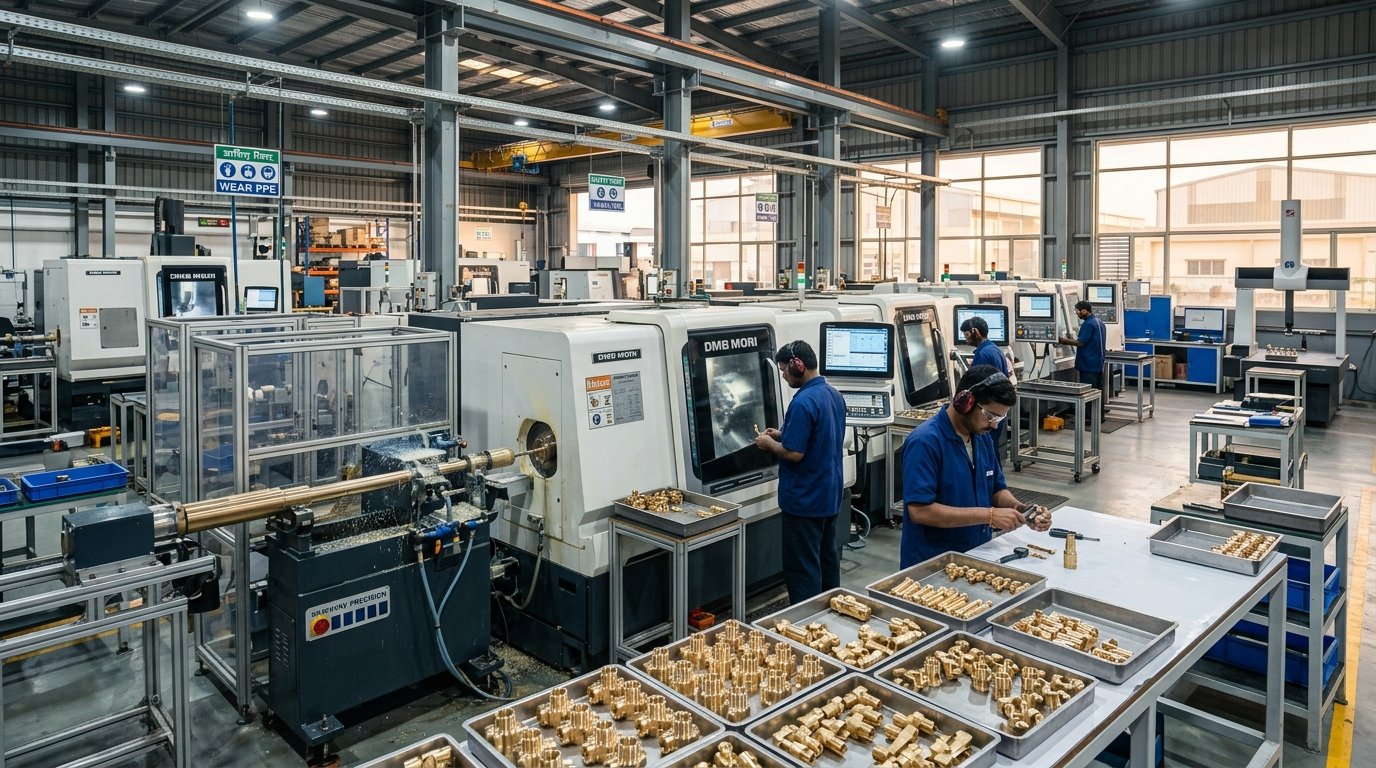
Castings rarely come out of the mold ready for use. Post-casting machining is almost always required. Surfaces that need to mate with other components, threaded sections, and precision bores are finished on CNC equipment. Additionally, casting defects like flash, gates, and risers must be ground off or sawed away before finishing.
At Divine Brass Industries, we are deeply familiar with casting alloys and the secondary machining required to bring raw castings to final tight tolerances.
Frequently Asked Questions
What is the continuous casting process for brass rod manufacturing?
Continuous casting involves melting brass scrap and virgin ingots in an induction furnace at 1020°C–1080°C, then drawing the liquid metal through water-cooled graphite dies to produce solid, dense, void-free billet rods.
How does sand casting compare with investment casting for complex brass parts?
Sand casting offers lower tooling costs for large, heavy castings (>5 kg). Investment (lost-wax) casting delivers far tighter tolerances (±0.05 mm) and ultra-smooth surface finishes (Ra 1.6 µm) for intricate valve bodies.
Why is spectro-analysis critical during brass casting runs?
Spectrochemical analysis verifies exact elemental ratios (Cu 57-59%, Pb 2.5-3.5%) in real time before pouring, preventing alloy degradation and ensuring strict compliance with EN 12164 specifications.