One of the most common points of confusion in global brass sourcing is the myriad of alloy designation systems. An engineer in the US might request "C36000," while a buyer in the UK asks for "CZ121," and a manufacturer in Europe works with "CW614N." The reality is, these are functionally equivalent free-machining brass alloys.
The Systems Explained
- UNS (Unified Numbering System): Primarily used in North America. Brass alloys begin with the letter 'C' followed by five digits (e.g., C36000).
- BS (British Standards): The traditional UK system, though largely superseded by EN standards, is still widely used colloquially (e.g., CZ121).
- EN (European Norms): The modern European standard. Brass alloys start with 'CW' followed by a three-digit number and a letter indicating the primary element (e.g., CW614N).
- JIS (Japanese Industrial Standards): Japanese standards use 'C' followed by four digits (e.g., C3604).
Cross-Reference Table: Free-Machining Brass
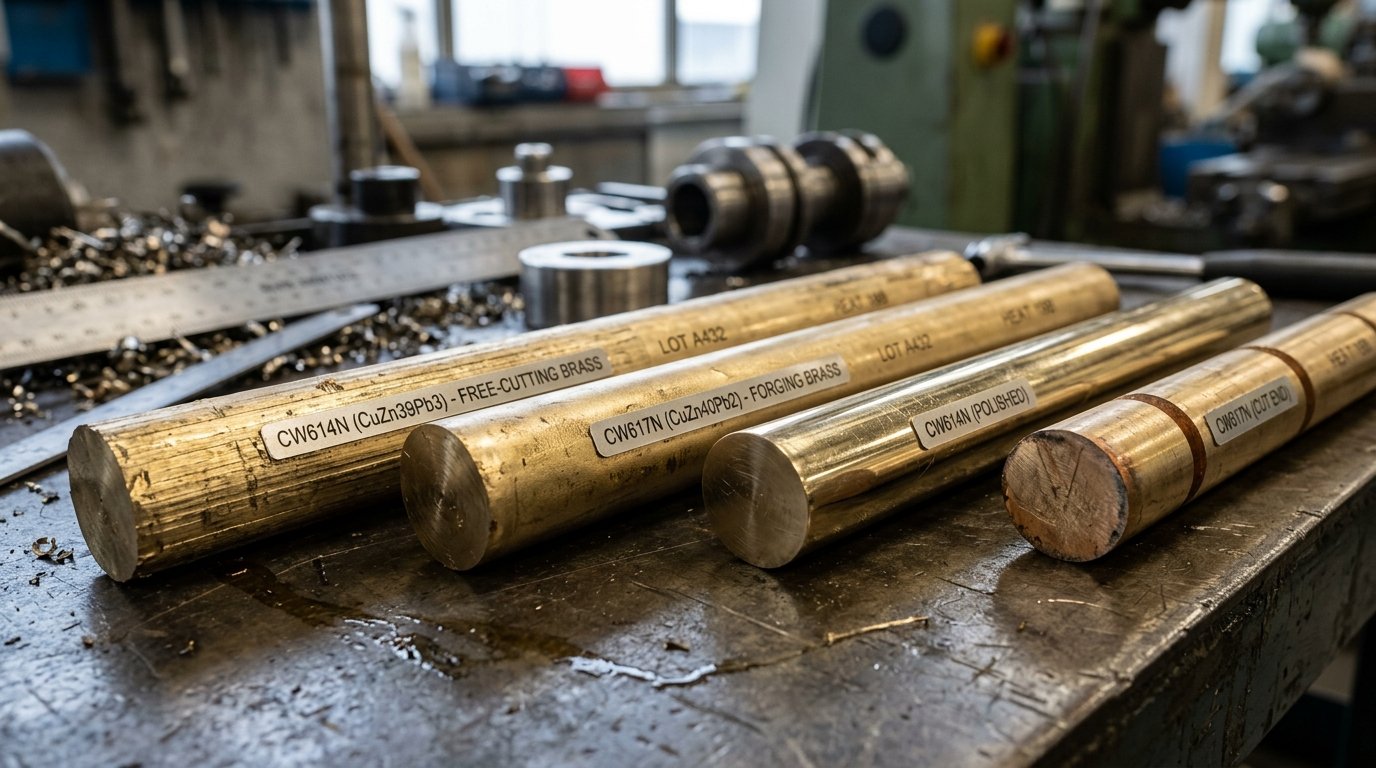
Free-machining brass is the industry standard for high-speed turning operations due to the addition of lead, which acts as a lubricant and chips breaker.
| Standard System | Alloy Designation | Region of Primary Use |
|---|---|---|
| UNS (ASTM) | C36000 | North America |
| BS (Obsolete, but common) | CZ121 (CZ121Pb3) | UK & Commonwealth |
| EN | CW614N | Europe |
| JIS | C3604 | Japan / Asia |
| IS (Indian Standard) | IS 319 (Type 1 or 2) | India |
Minor Compositional Differences
While these alloys are considered equivalent, they are not strictly identical. For instance, C36000 typically has a slightly tighter tolerance on its lead content (2.5 - 3.7%) compared to some regional equivalents. However, for 95% of general machining applications, they can be used interchangeably.
Conclusion
When drafting an RFQ for global sourcing, it is best practice to list the desired material standard but also state "or equivalent" (e.g., "Material: C36000 or equivalent EN CW614N / IS 319"). This gives your supplier the flexibility to use locally available, structurally equivalent raw materials, often saving you money and reducing lead times.
Frequently Asked Questions
Is British CZ121 brass identical to American C36000 brass?
Yes. CZ121 (BS 2874), C36000 (ASTM B16), and CW614N (EN 12164) are direct transatlantic equivalents with 57-59% Cu and 2.5-3.5% Pb composition.
What tensile strength values are specified for CZ121 and C36000?
Both alloys deliver tensile strengths of 360 to 500 MPa and hardness values between 110 and 150 HV in the half-hard (H02) temper condition.
Can Divine Brass produce parts matching both ASTM and BS specifications?
Yes. Divine Brass dual-certifies turned components to both ASTM B16 C36000 and BS 2874 CZ121 / EN 12164 specs.