
When engineering brass components, selecting the right alloy is crucial for balancing manufacturing costs, component performance, and regulatory compliance. Two of the most commonly specified European standard brass alloys are CW614N (CuZn39Pb3) and CW617N (CuZn40Pb2).
While their chemical compositions appear remarkably similar on paper, their distinct microstructures dictate vastly different ideal manufacturing processes. In this guide, we dive deep into the differences between CW614N and CW617N to help you make the most informed decision for your next project.
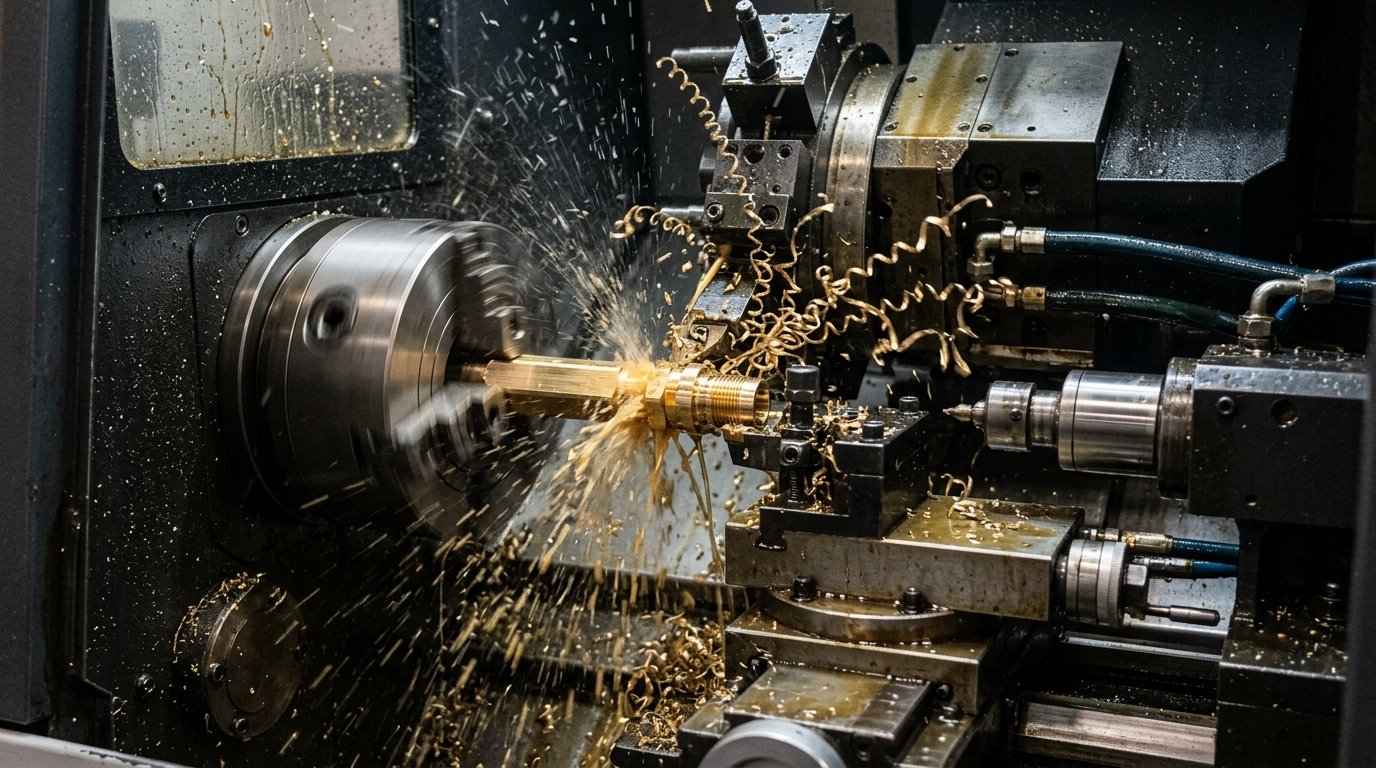
CW614N (CuZn39Pb3): The Machining Champion
CW614N, also known by its chemical designation CuZn39Pb3, contains approximately 58% copper, 39% zinc, and up to 3% lead. It is widely considered the standard "free-machining" brass in Europe.
The higher lead content in CW614N acts as a microscopic lubricant during cutting operations. It helps break up chips into small, manageable pieces rather than long stringers, significantly reducing tool wear and allowing for exceptional cutting speeds on Swiss CNC lathes and automated turning centers. It boasts a 100% machinability rating, setting the benchmark for all other copper alloys.
CW617N (CuZn40Pb2): The Forging Specialist
CW617N (CuZn40Pb2) slightly shifts the balance with roughly 58% copper, 40% zinc, and a lower lead content of about 2%. This specific composition makes CW617N the premier choice for hot stamping and forging applications.
When heated to temperatures between 680°C and 780°C, CW617N exhibits excellent plastic deformation properties. It flows easily into complex closed-die forging molds without cracking or tearing. While it can still be machined effectively post-forging, its machinability rating is slightly lower than CW614N.
Direct Comparison: Composition and Properties
| Property / Feature | CW614N (CuZn39Pb3) | CW617N (CuZn40Pb2) |
|---|---|---|
| Primary Use Case | High-speed CNC Machining & Turning | Hot Forging & Stamping |
| Lead (Pb) Content | 2.5% - 3.5% | 1.6% - 2.5% |
| Machinability Rating | 100% (The Standard) | Good, but lower than CW614N |
| Hot Forgeability | Fair / Moderate | Excellent (680°C - 780°C) |
| Typical Applications | Precision turned parts, sensor housings, fasteners, custom inserts | Valve bodies, water fittings, sanitary parts, complex shapes |
Cost Implications and Selection Strategy
For high-volume production of geometrically simple or highly precise cylindrical parts, CW614N is usually the most cost-effective route due to the sheer speed at which parts can be turned from rod stock on modern CNC equipment.
However, if your component has a complex, bulky shape (like a plumbing valve or a T-fitting), machining it out of solid CW614N bar would result in excessive material waste. In these cases, hot forging a CW617N billet near to the net shape and then performing secondary machining is far more economical and produces a structurally superior part with a better grain structure.
Be sure to consider how your choice integrates with your overall supply chain. You can rely on our expertise at Divine Brass Industries to recommend the most optimal path.
Frequently Asked Questions
Can CW617N forging brass be machined on CNC turning centers?
Yes. CW617N has a good machinability rating (~80%), making it ideal for post-forging secondary operations like thread tapping and valve seat facing.
Why is CW614N preferred over CW617N for turned electronic pins?
CW614N contains 3% lead, providing perfect chip breakability and superior surface finish (Ra 0.4 µm) directly off high-speed Swiss lathes.
What are the raw material cost differences between CW614N and CW617N?
Base raw material billet prices are virtually identical; the choice depends entirely on whether the primary manufacturing step is hot stamping (CW617N) or bar turning (CW614N).