Material Overview & Composition
Solid brass is a copper-zinc alloy with density 8.4-8.73 g/cm3. Key alloys include CW614N (free-cutting, 57-59% Cu, 3% Pb) and CW617N (forging, 58-60% Cu, 2% Pb). Stainless steel is an iron-chromium alloy (min 10.5% Cr) with density 7.93 g/cm3.
Primary grades are 304 (18% Cr, 8% Ni) and 316L (16% Cr, 10% Ni, 2% Mo).
Manufacturing & Machining Comparison
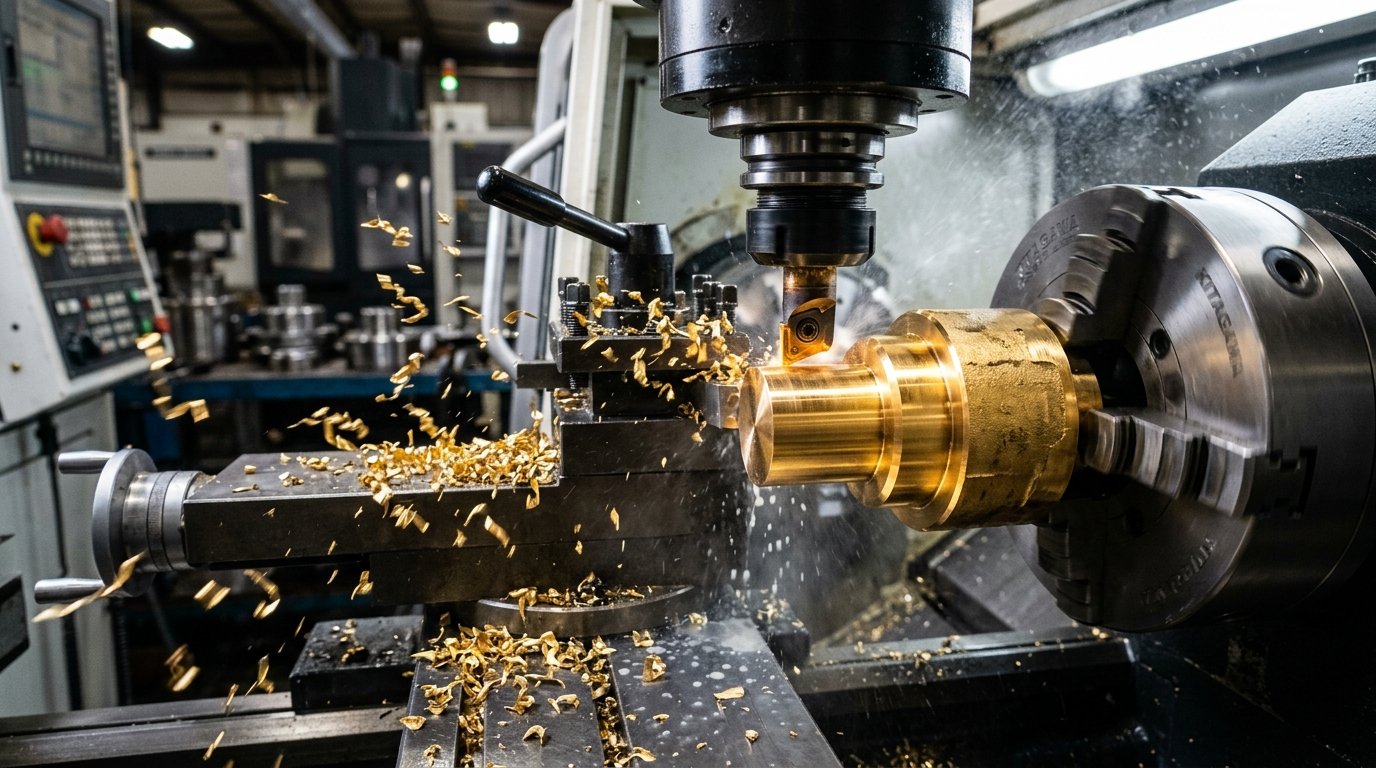
Brass is the gold standard for machinability at 100% rating. CNC turning speeds reach 200-300 m/min with tool life of 3,000-5,000 parts per carbide insert. Stainless steel machines at 60-120 m/min with tool life of 800-1,500 parts.
Brass generates clean, short chips versus stringy, problematic stainless steel chips.
| Selection Factor | Solid Brass | Stainless Steel | Winner |
|---|---|---|---|
| Machinability | 100% | 45% | Brass |
| Thermal Conductivity | 109-121 W/mK | 16 W/mK | Brass |
| Corrosion (chemicals) | Limited | Excellent | Stainless |
| Antimicrobial | Yes (EPA registered) | No | Brass |
| Recyclability | 100% (high scrap value) | 100% (lower scrap value) | Brass |
| Raw Strength | 350-400 MPa | 515 MPa | Stainless |
| Total Cost | 35-50% lower | Higher | Brass |
Antimicrobial Properties
Brass has inherent antimicrobial properties. The EPA registered copper alloys (including brass with 60%+ copper) as antimicrobial surfaces. Stainless steel has no antimicrobial properties.
This makes brass ideal for door handles, plumbing fixtures, and hospital hardware in infection control.
Environmental & Sustainability Comparison
Brass is 100% recyclable with no degradation in quality. Recycled brass requires 60-70% less energy than primary production. Brass scrap retains 60-70% of virgin material value versus 30-40% for stainless steel scrap.
Both materials have long service lives, but brass has a stronger circular economy profile.
| Selection Factor | Solid Brass | Stainless Steel | Winner |
|---|---|---|---|
| Machinability | 100% | 45% | Brass |
| Thermal Conductivity | 109-121 W/mK | 16 W/mK | Brass |
| Corrosion (chemicals) | Limited | Excellent | Stainless |
| Antimicrobial | Yes (EPA registered) | No | Brass |
| Recyclability | 100% (high scrap value) | 100% (lower scrap value) | Brass |
| Raw Strength | 350-400 MPa | 515 MPa | Stainless |
| Total Cost | 35-50% lower | Higher | Brass |
Frequently Asked Questions
What is better, brass or stainless steel?
It depends on the application. Brass is better for 80% of precision components, plumbing, electrical, and decorative applications due to superior machinability, conductivity, and lower cost. Stainless steel is better for extreme chemical environments, food processing, and structural load-bearing applications.
Is solid brass better quality than stainless steel?
Neither is inherently higher quality. Both are engineering materials with distinct advantages. Brass is higher quality for electrical components, plumbing, and precision turned parts. Stainless steel is higher quality for chemical processing and surgical instruments.
Which material is more eco-friendly?
Brass has a slight edge. It is 100% recyclable with higher scrap value (60-70% vs 30-40%), requires less energy to recycle, and has inherent antimicrobial properties reducing chemical disinfectant needs.