Defining Strength Parameters
Material strength encompasses multiple properties: tensile strength (maximum stress before fracture), yield strength (stress at which permanent deformation begins), hardness (resistance to surface indentation), and fatigue strength (resistance to cyclic loading). No single number captures overall strength.
Brass Strength Data by Alloy
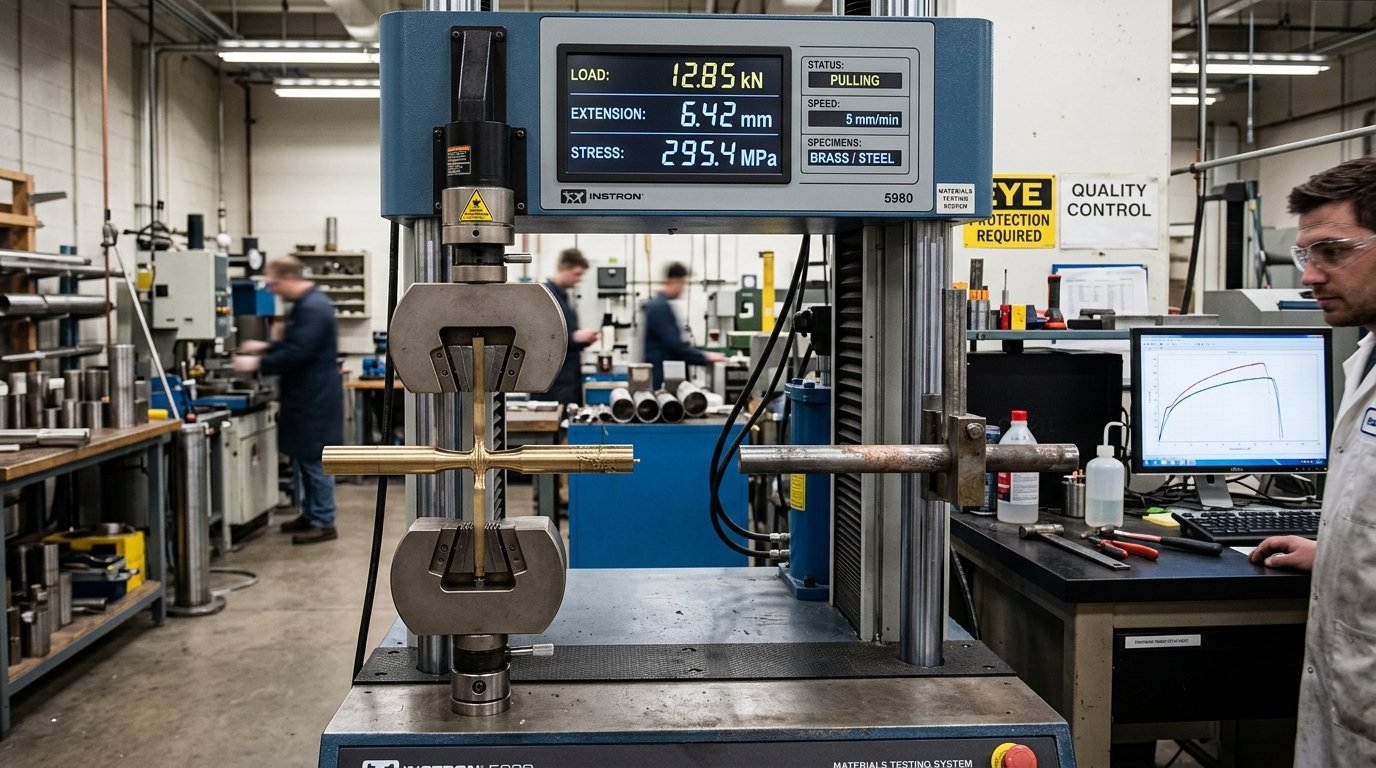
CW614N free-cutting brass has tensile strength of 350-400 MPa and yield strength of 250-310 MPa. CW617N forging brass achieves 380-460 MPa tensile and 170-350 MPa yield. Naval brass C46400 reaches 500+ MPa tensile.
High-tensile manganese brass can exceed 600 MPa.
| Strength Property | CW614N Brass | CW617N Brass | 304 Stainless |
|---|---|---|---|
| Tensile Strength (MPa) | 350-400 | 380-460 | 515 |
| Yield Strength (MPa) | 250-310 | 170-350 | 205 |
| Elongation (%) | 10-20 | 15-30 | 40 |
| Hardness (HB) | 100-160 | 80-150 | 130-180 |
| Fatigue Strength (MPa) | 140-180 | 150-200 | 210-240 |
Stainless Steel Strength Data
304 stainless steel has tensile strength of 515 MPa and yield strength of 205 MPa. 316L achieves 485 MPa tensile and 170 MPa yield. Notably, brass yield strength (250-310 MPa for CW614N) actually exceeds 304 stainless steel yield strength (205 MPa), meaning brass resists permanent deformation better in many cases.
Practical Strength Implications
For most precision component applications, both brass and stainless steel provide adequate strength. The deciding factors are typically machinability, conductivity, corrosion resistance, and cost rather than raw strength. Brass components manufactured by Divine Brass achieve tolerances of plus or minus 0.005 mm regardless of strength grade.
| Strength Property | CW614N Brass | CW617N Brass | 304 Stainless |
|---|---|---|---|
| Tensile Strength (MPa) | 350-400 | 380-460 | 515 |
| Yield Strength (MPa) | 250-310 | 170-350 | 205 |
| Elongation (%) | 10-20 | 15-30 | 40 |
| Hardness (HB) | 100-160 | 80-150 | 130-180 |
| Fatigue Strength (MPa) | 140-180 | 150-200 | 210-240 |
Frequently Asked Questions
Is brass stronger than stainless steel?
Stainless steel has higher ultimate tensile strength (515 MPa vs 350-400 MPa for CW614N brass). However, brass yield strength (250-310 MPa) exceeds 304 stainless steel yield strength (205 MPa), meaning brass resists permanent deformation better in many scenarios.
Is brass harder than stainless steel?
They are comparable. CW614N brass measures 100-160 HB versus 130-180 HB for 304 stainless steel. Cold-worked brass can achieve hardness values overlapping with stainless steel ranges.
Is brass more ductile than stainless steel?
Stainless steel generally has higher elongation (40% for 304 SS vs 10-20% for CW614N). However, CW617N forging brass achieves 15-30% elongation with excellent hot workability for forging applications.