Tensile Strength Comparison
Carbon steel achieves tensile strengths of 400-550 MPa (mild steel) up to 1200 MPa (high-carbon), while brass alloys typically range from 310-500 MPa depending on composition. CW614N free-cutting brass achieves 350-400 MPa, and CW617N forging brass reaches 380-460 MPa. High-strength naval brass C46400 can reach 500+ MPa.
Yield Strength & Hardness Analysis
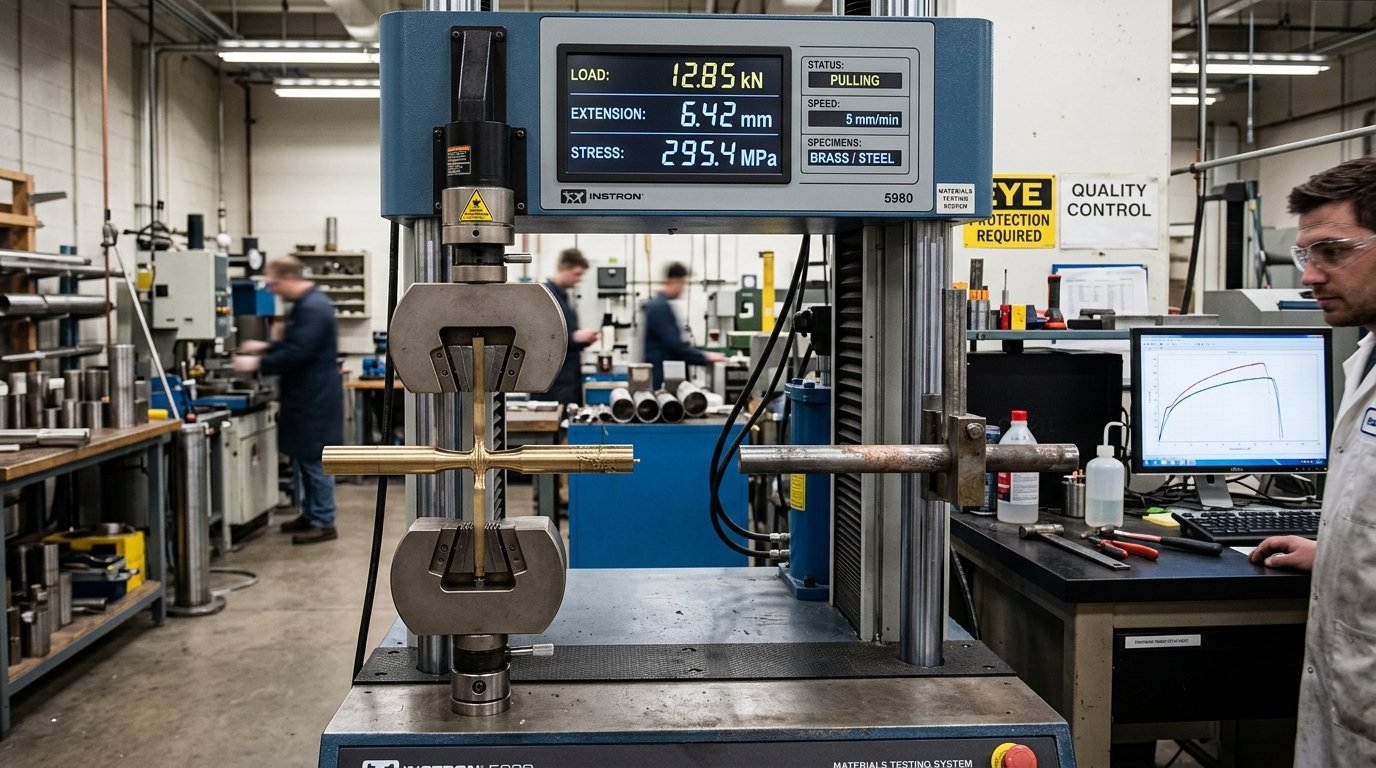
Brass yield strength ranges from 120-380 MPa across common alloys. CW614N yields at 250-310 MPa compared to mild steel at 250 MPa. On the Brinell hardness scale, CW614N brass measures 100-160 HB while mild steel is 120-180 HB.
The numbers are surprisingly close for many applications.
| Property | CW614N Brass | Mild Steel | 304 Stainless |
|---|---|---|---|
| Tensile Strength (MPa) | 350-400 | 400-550 | 515 |
| Yield Strength (MPa) | 250-310 | 250 | 205 |
| Hardness (HB) | 100-160 | 120-180 | 130-180 |
| Machinability (%) | 100 | 65 | 45 |
| Density (g/cm3) | 8.47 | 7.85 | 7.93 |
Fatigue & Impact Resistance
Steel generally exhibits superior fatigue resistance, making it better for cyclically loaded structural components. However, brass excels in vibration damping applications. Brass has better impact resistance at sub-zero temperatures compared to carbon steel, which can become brittle.
This makes brass ideal for cryogenic fittings and valves.
Application-Based Material Selection
For structural load-bearing components, steel is the clear choice. For precision-machined parts requiring good strength with superior machinability, brass wins. In plumbing, gas fittings, and electrical components, brass outperforms steel due to its corrosion resistance and machinability combination.
| Property | CW614N Brass | Mild Steel | 304 Stainless |
|---|---|---|---|
| Tensile Strength (MPa) | 350-400 | 400-550 | 515 |
| Yield Strength (MPa) | 250-310 | 250 | 205 |
| Hardness (HB) | 100-160 | 120-180 | 130-180 |
| Machinability (%) | 100 | 65 | 45 |
| Density (g/cm3) | 8.47 | 7.85 | 7.93 |
Frequently Asked Questions
Is brass stronger than steel?
In terms of ultimate tensile strength, steel is generally stronger. Mild steel achieves 400-550 MPa vs CW614N brass at 350-400 MPa. However, brass has comparable yield strength and significantly better machinability, making it stronger in terms of manufacturing efficiency.
Which is harder, brass or steel?
They are surprisingly close. CW614N brass measures 100-160 HB compared to mild steel at 120-180 HB. For hardened steel, the gap widens significantly. Brass hardness can be increased through cold working.
Can brass replace steel in structural applications?
Not typically. Brass is not suitable for primary structural load-bearing members. However, brass excels in non-structural precision components, fittings, connectors, and valve bodies where machinability and corrosion resistance are prioritized over raw strength.