Understanding Corrosion Mechanisms
Corrosion is the gradual degradation of metals through chemical reactions with their environment. Brass and stainless steel resist corrosion through fundamentally different mechanisms. Brass forms a natural patina layer of copper oxide that shields the underlying metal, while stainless steel relies on a self-healing chromium oxide passive film.
Brass Corrosion Performance
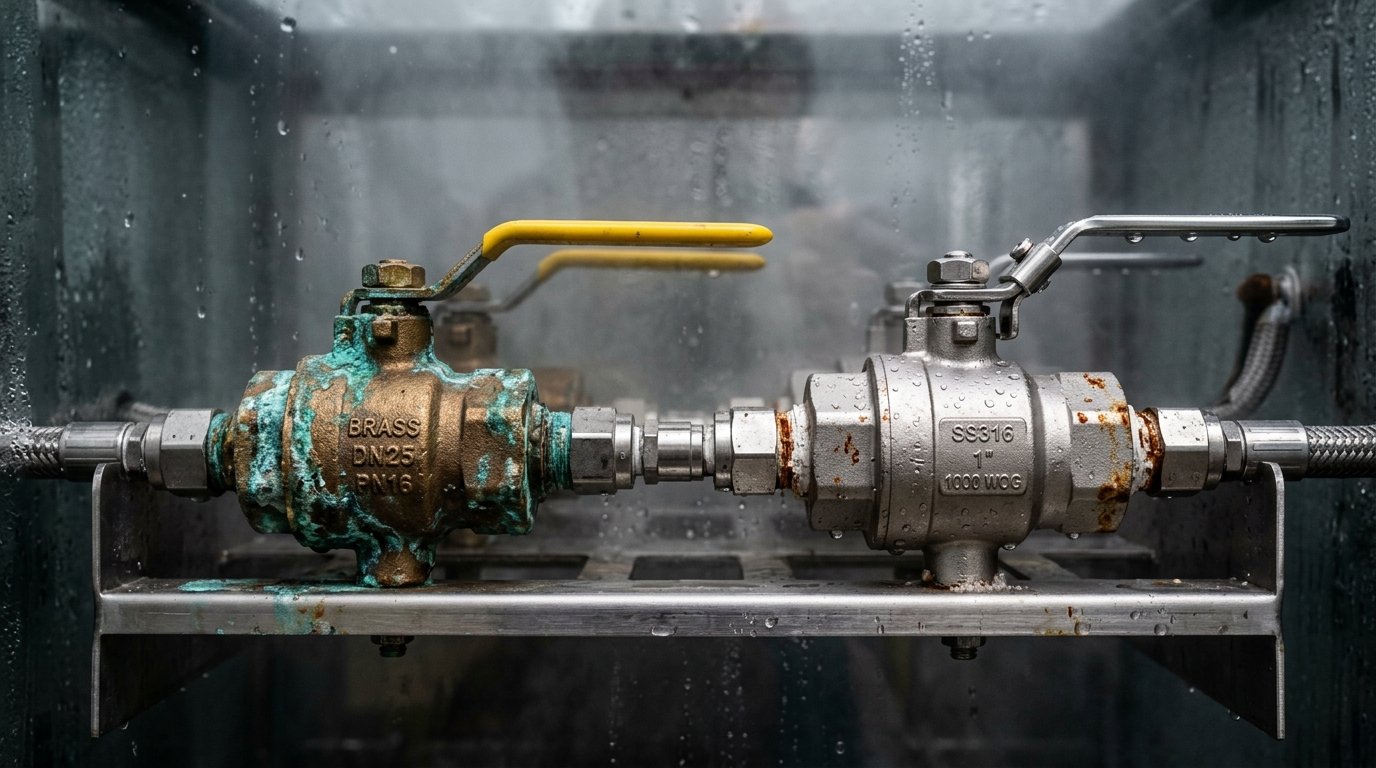
Brass alloys demonstrate excellent corrosion resistance in many environments. CW614N (CuZn39Pb3) performs well in atmospheric and freshwater conditions. However, dezincification can occur in aggressive water chemistry.
DZR brass (CW602N) with arsenic addition prevents this, making it ideal for potable water systems. Brass density ranges from 8.4 to 8.73 g/cm3 depending on alloy composition.
| Environment | Brass (CW602N DZR) | Stainless Steel (316L) |
|---|---|---|
| Freshwater/Plumbing | Excellent (WRAS approved) | Excellent |
| Seawater/Marine | Good (with DZR) | Superior |
| Atmospheric | Excellent (patina forms) | Excellent |
| Chemical/Acid | Limited | Superior |
| Cost Efficiency | 35-45% lower | Higher initial cost |
Stainless Steel Corrosion Performance
Stainless steel grades like 304 and 316 offer superior resistance to a broader range of chemicals. 316L with molybdenum excels in chloride-rich marine environments. However, stainless steel is susceptible to crevice corrosion and stress corrosion cracking in specific conditions that brass handles well.
Head-to-Head Comparison by Environment
In freshwater plumbing, DZR brass (CW602N) outperforms 304 stainless steel on cost-effectiveness while matching corrosion resistance. In marine applications, 316 stainless steel leads. In atmospheric exposure, brass develops an attractive patina while maintaining structural integrity for 50+ years.
For valve bodies and fittings, brass offers 35-45% cost savings over stainless steel with comparable longevity.
| Environment | Brass (CW602N DZR) | Stainless Steel (316L) |
|---|---|---|
| Freshwater/Plumbing | Excellent (WRAS approved) | Excellent |
| Seawater/Marine | Good (with DZR) | Superior |
| Atmospheric | Excellent (patina forms) | Excellent |
| Chemical/Acid | Limited | Superior |
| Cost Efficiency | 35-45% lower | Higher initial cost |
Frequently Asked Questions
Does brass corrode faster than stainless steel?
In most freshwater and atmospheric environments, brass and stainless steel corrode at similar rates. DZR brass (CW602N) is specifically engineered to resist dezincification in aggressive water conditions. The choice depends on the specific environment rather than a blanket superiority of one metal.
Which is better for outdoor applications: brass or stainless steel?
Both perform well outdoors. Brass develops an attractive green patina over time while maintaining structural integrity. Stainless steel retains its silver appearance. For architectural fittings, brass is often preferred for its aesthetic aging qualities.
Can brass be used in saltwater environments?
Yes, but specific alloys are recommended. Naval brass (C46400) and aluminum bronze are designed for marine use. Standard free-cutting brass CW614N should be avoided in direct seawater contact. DZR brass CW602N offers good saltwater resistance for valve applications.